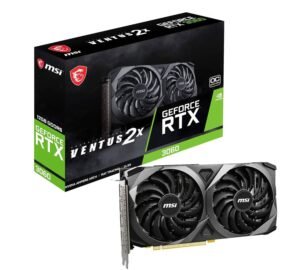
NVIDIA RTX Graphics Cards represent a family of dedicated graphics processing units (GPUs) designed for gaming, content creation, professional visual computing, and artificial intelligence workloads.
Key Features and Architecture
- Dedicated RT Cores (Ray Tracing): Specialized hardware modules simulate the physical behavior of light in real time. This enables accurate reflections, realistic global illumination, soft shadows, and translucent effects.
- Tensor Cores (AI & Machine Learning): Silicon units optimized for matrix math and deep learning operations. They power technologies like DLSS (Deep Learning Super Sampling), which upscales lower-resolution frames using AI to boost framerates without sacrificing visual fidelity.
- High-Speed VRAM: Equipped with high-bandwidth GDDR6/GDDR6X memory configurations to handle large texture maps, high-resolution display outputs (4K/8K), and heavy AI datasets.
Core Use Cases
| Category | Primary Benefit | Key Technologies Used |
| Gaming | High framerates at high resolutions with photorealistic light physics. | DLSS, Hardware Ray Tracing, Reflex (Low Latency) |
| Content Creation | Faster render times in 3D modeling, video editing, and color grading. | NVIDIA Studio Drivers, OptiX API, CUDA |
| AI & Development | Local execution of large language models (LLMs), image generation, and model training. | Tensor Cores, TensorRT, CUDA Acceleration |
Card Generations Overview
- RTX 20 Series (Turing Architecture): Introduced real-time ray tracing and Tensor Cores to mainstream GPUs.
- RTX 30 Series (Ampere Architecture): Delivered generational jumps in rasterization, ray tracing performance, and power efficiency.
- RTX 40 Series (Ada Lovelace Architecture): Introduced DLSS 3 Frame Generation, SER (Shader Execution Reordering), and significantly lower power draw per frame.
- RTX 50 Series (Blackwell Architecture): Built for high-density neural graphics, advanced ray-reconstruction capabilities, and local AI computing.